5 Coffee Rituals That Make a Dark Morning Genuinely Easier
Quick Answer: Five ritual changes make dark mornings measurably easier: prep the coffee the night before so the first decision of the day is already made, move the drinking spot to your brightest window, delay the first cup slightly rather than drinking it in bed, add a warm-up manual step like a pour-over that gives your hands something to do while you wake, and set a firm cut-off time so the morning ritual doesn’t cost you the evening. None of these are about the coffee being better. They’re about the coffee carrying the morning.
The alarm goes off in the dark and the gap between waking and functioning gets wider every week from here. That gap is where a ritual earns its place.

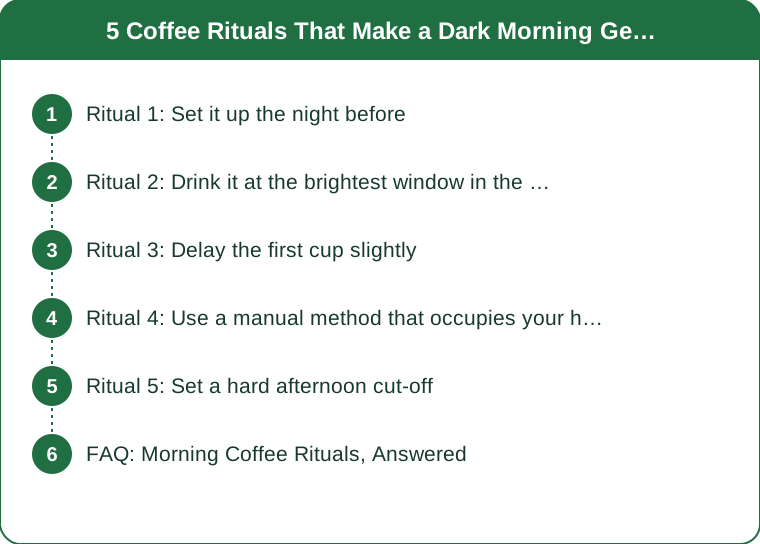
Ritual 1: Set it up the night before
The first decision of the day is the expensive one. Waking into darkness and immediately facing a sequence of small choices - which coffee, how much, where’s the filter - is a surprisingly heavy start when you’re not yet awake.
Do the whole setup at night. Water in the kettle or machine, grounds measured, mug out, spoon out. It takes ninety seconds in the evening when you’re functional and it removes every decision from the morning when you’re not.
Timers are the strongest version of this. A machine that starts before your alarm means you wake to the smell of coffee, which is a genuinely different experience from waking to a dark kitchen and a cold kettle.
Grind the night before if you must, freshness be damned. Slightly stale coffee you actually drink beats a perfect grind you skip because it was too much effort at 6am. Convenience beats purity for a weekday ritual.
And leave the mug somewhere you’ll see it. A visual cue on the counter does more for a morning habit than any intention set the night before.
This is the single highest-value change on the list, and it’s the one nobody bothers with because it happens at the wrong end of the day.
Ritual 2: Drink it at the brightest window in the house
Light is the thing your body actually needs first thing. Morning light exposure is the main anchor for your body clock, and it becomes harder to get as sunrise moves later - so attaching it to something you already do daily is the practical solution.
Move the drinking spot, not the coffee. Same coffee, different chair. It’s the easiest habit change on this list because you’re not adding anything.
Outside beats a window, if the weather allows. Ten minutes on a doorstep or in a garden with a mug delivers vastly more light than the brightest indoor spot, even under cloud.
Face the light rather than sitting side-on to it. You don’t need to stare at anything - just having the light in your field of view is what matters.
Keep the phone out of it for the first few minutes. The point is to be awake and looking outward, and a screen at close range in a dark room is the opposite of the signal you’re trying to send.
The coffee is the vehicle. The light is the payload, and it’s the part that changes how the rest of the day feels.
Ritual 3: Delay the first cup slightly
Cortisol is naturally highest in the period after waking. Some people find caffeine taken immediately on waking does less than the same caffeine taken a little later, once that natural rise has started to fall.
The evidence is softer than the internet suggests. The delayed-coffee advice is widely repeated and the underlying research is less definitive than the confident version implies. Treat it as worth testing personally rather than as a rule.
What is reliable is the alertness dip later. Drinking coffee immediately on waking often means the effect has faded by mid-morning, which is when most people actually need it.
Try thirty to sixty minutes and see. Get up, get light, drink water, then coffee. Two weeks is enough to notice whether your mid-morning is steadier.
Water first matters more than timing. You wake mildly dehydrated after several hours without fluid, and a glass of water before coffee is a low-effort change with a noticeable effect on how a morning feels.
If delaying makes your morning worse, don’t delay. Personal response varies enough that this one is genuinely a test rather than a rule.

Ritual 4: Use a manual method that occupies your hands
The waking gap needs filling with something. Five minutes of a simple manual task - pour-over, French press, moka pot - occupies the transition between asleep and functional far better than standing waiting for a machine.
Warmth and repetition are the point, not the flavour. The kettle, the steam, the pouring, the same movements in the same order. It’s a low-demand routine that gets you moving without requiring decisions.
Pour-over is the most forgiving to learn. A cone, a filter, and a kettle. The technique matters less than people claim for a weekday cup, and it takes about four minutes.
Keep the equipment out on the counter. Anything stored in a cupboard becomes a weekend-only method within a fortnight.
Make it the same every day. The value comes from the repetition, not the variety. Save experimentation for weekends when you have the attention for it.
On dark mornings, a ritual that gives your hands a job is doing something that no amount of caffeine does on its own.
Ritual 5: Set a hard afternoon cut-off
Caffeine has a long tail. Its half-life means a meaningful amount is still circulating many hours after you drink it, which is why an afternoon cup can affect sleep even when you fall asleep normally.
Pick a fixed time rather than a rule about cups. Two in the afternoon, or six hours before bed, whichever is earlier. A time is easier to follow than a quantity.
Sleep quality is what makes tomorrow’s dark morning survivable. The whole point of building a good morning ritual is undermined if the ritual costs you the sleep that makes mornings possible.
Have a designated afternoon replacement. Decaf, herbal tea, or a short walk. The habit of stopping and making a hot drink is often what you want at 4pm rather than the caffeine.
Watch the total, not just the timing. General guidance for most healthy adults sits around 400mg of caffeine a day, which is roughly four cups of brewed coffee - and it’s easy to exceed without noticing when mornings get hard.
This is general information, not medical advice. If you’re pregnant, take medication, or have a heart or anxiety condition, your appropriate caffeine level may be different and it’s worth asking a clinician.
FAQ: Morning Coffee Rituals, Answered
Should I wait to drink coffee after waking up?
It’s worth testing rather than treating as a rule. The cortisol argument is repeated more confidently than the evidence supports, but many people do find a thirty to sixty minute delay gives them a steadier mid-morning.
Does coffee help with dark winter mornings?
Caffeine helps with alertness, but light does more for the underlying problem. The most effective version is combining them - drinking your coffee at the brightest available spot rather than in a dark kitchen.
When should I stop drinking coffee for the day?
A fixed cut-off is easier to keep than a cup limit - commonly early afternoon, or around six hours before bed. Caffeine’s half-life means an afternoon cup can still affect sleep quality even if you fall asleep fine.
How much coffee is too much?
General guidance for most healthy adults is around 400mg of caffeine a day, roughly four cups of brewed coffee. If you’re pregnant, on medication, or managing a heart or anxiety condition, that figure may be different - ask a clinician.
TL;DR:
- Set the whole thing up the night before - it removes every decision from the moment you’re least able to make them.
- Drink it at the brightest window or outside; light is what your body clock actually needs on a dark morning.
- Test a thirty to sixty minute delay before the first cup, with water first, and keep it only if your mid-morning improves.
- Use a manual method that occupies your hands for five minutes - the ritual does work that caffeine doesn’t.
- Set a fixed afternoon cut-off, because tomorrow’s dark morning depends on tonight’s sleep.
The coffee isn’t the point. It’s the thing you attach light, warmth, and movement to when the alarm goes off into the dark.
Keep Reading
This article is for general informational purposes only and is not medical advice. Always consult a qualified health professional for guidance specific to you.