5 Ways to Make Your Morning Coffee Better as the Mornings Cool
Quick Answer: A kitchen that is 5-8C / 10-15F cooler pulls heat out of your brew fast, and cooler water extracts less - so the same recipe that was balanced in July tastes thin and sour in October. Preheat everything, grind slightly finer, and expect to adjust rather than assuming the beans went stale. Five specific changes cover almost all of it.
Same beans, same grinder, same routine, and yet the cup is somehow flatter. Autumn does this every year and almost nobody connects it to the room temperature.

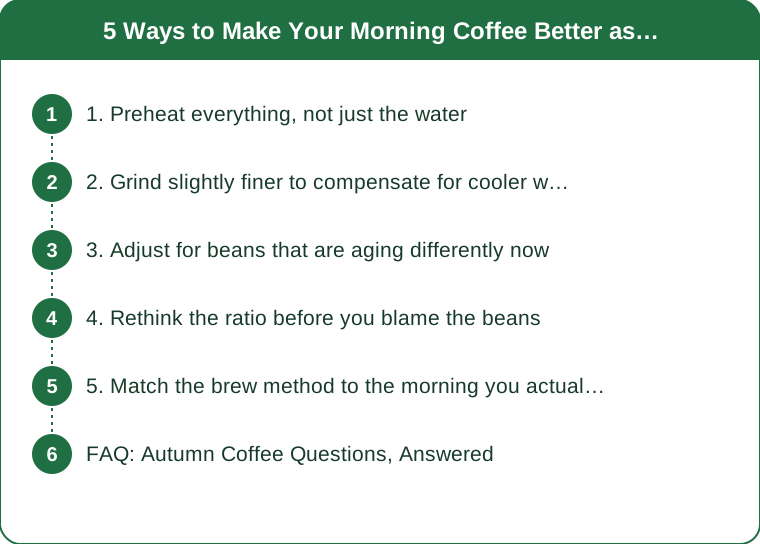
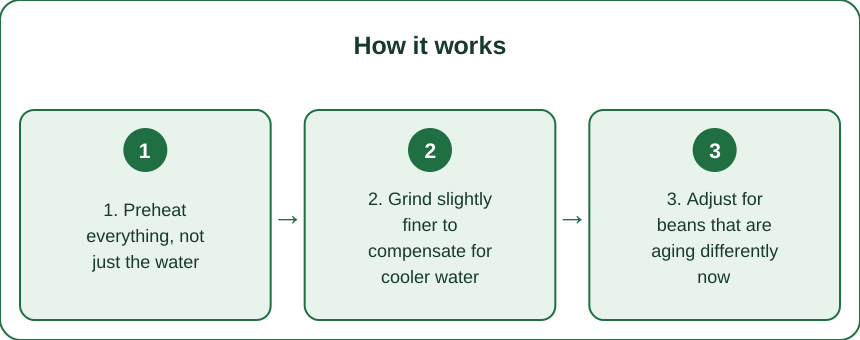
1. Preheat everything, not just the water
This is the largest single improvement and it costs nothing.
Brewing is a heat-loss problem. Your water leaves the kettle around 93-96C / 200-205F, then immediately starts giving heat to the dripper, the carafe, the mug, and the room. In a warm kitchen that loss is modest. In a 17C / 63F kitchen, a cold ceramic dripper can pull the brew slurry down several degrees within the first thirty seconds - right when most of the extraction happens.
What to preheat: rinse the dripper and carafe with hot water and discard it. Pour hot water into your mug and tip it out just before serving. If you use a French press, fill it with hot water while the kettle finishes and empty it right before you brew.
How much difference does it make? Enough to move a cup from noticeably sour to balanced. Under-extraction reads as sour, thin, and sharp, and cool brewing temperature is the most common cause of it in autumn.
One more detail: a metal dripper loses heat faster than ceramic, and ceramic takes longer to preheat but holds temperature better once warm. Give a ceramic dripper a full ten seconds of hot water rather than a quick splash.
2. Grind slightly finer to compensate for cooler water
Extraction depends on temperature, time, and surface area. If temperature falls, you can raise one of the other two.
Grinding finer increases surface area, which increases extraction rate and offsets some of the heat loss. The adjustment is small - one or two steps finer on most grinders, not a dramatic change.
Or extend the brew time, which achieves something similar. For a French press, moving from four minutes to four and a half is a reasonable autumn adjustment. For pour-over, a slightly slower pour does the same thing.
Do one at a time. Changing grind and time together makes it impossible to know what worked, and coffee variables interact enough that you will end up over-correcting.
How to know which direction you need: taste is the guide, and it is more reliable than people expect once you know the two failure modes. Sour, sharp, thin, lacking sweetness means under-extracted - go finer or longer. Bitter, drying, hollow, harsh means over-extracted - go coarser or shorter. Autumn problems are almost always in the under-extracted direction.
3. Adjust for beans that are aging differently now
Storage conditions change with the season and it affects your beans on a real timeline.
Cooler, drier air is actually kinder to coffee than warm humid air, so beans stored on a counter degrade slightly more slowly now than they did in August. That is the good news.
The bad news is degassing. Freshly roasted coffee releases carbon dioxide for a week or two after roasting, and CO2 interferes with water contacting the grounds - which is why very fresh coffee blooms so dramatically and can brew unevenly. Degassing happens more slowly at cooler temperatures, so a bag that would have been ready at day four in summer may want day six now.
Practical adjustments: give the bloom an extra ten to fifteen seconds if your coffee is very fresh, and use roughly twice the weight of the grounds in water for the bloom - 30g of water for 15g of coffee.
Storage rules that matter more than the season: airtight container, away from light, at room temperature. Do not store coffee in the fridge - the temperature swings cause condensation every time you open it, and coffee readily absorbs odors. The freezer works for long-term storage of unopened bags but is a poor place for the bag you use daily.

4. Rethink the ratio before you blame the beans
Most people never weigh anything, and volume measurement drifts substantially with grind size and bean density.
Start from a known ratio. A 1:16 coffee-to-water ratio by weight - 15g of coffee to 240g of water - is a reliable middle for pour-over and drip. French press often works better slightly stronger at 1:15. From there you adjust to taste, but you adjust from a number rather than from a scoop.
A basic kitchen scale is the highest-value coffee purchase under twenty dollars, well ahead of any brewing device upgrade. Scoops measure volume, and the same scoop of a dense light roast and a puffy dark roast differ meaningfully in weight.
Autumn ratio note: as it gets cooler, many people want a slightly stronger, more comforting cup, and that preference is legitimate rather than a mistake. Moving from 1:16 to 1:15 is a deliberate strength change and it is different from fixing an extraction problem. Know which one you are doing - a stronger cup that is still under-extracted just tastes more intensely sour.
Water matters too. Very soft or distilled water extracts poorly and tastes flat, and very hard water mutes acidity and scales your kettle. Filtered tap water is the practical sweet spot for almost everyone.
5. Match the brew method to the morning you actually have
The best method is the one that fits the fifteen minutes you have, and autumn mornings are usually more rushed than summer ones.
French press is the most forgiving in a cold kitchen because the thick glass or steel body and the long immersion time buffer heat loss well. It also requires the least attention - grind, pour, wait, press. Coarse grind, four minutes, and a preheated vessel.
Pour-over gives the most control and the cleanest cup, and it is the most sensitive to a cold room and a distracted brewer. Excellent on a slow weekend morning, frustrating on a school run morning.
Moka pot genuinely comes into its own in autumn - it produces a strong, warming cup, it is entirely stovetop, and the whole apparatus stays hot. Use pre-heated water in the base and take it off the heat as soon as it starts sputtering.
Batch drip is underrated. A decent machine with a preheated carafe makes very good coffee with zero attention, and for a household where more than one person is drinking, it is more practical than making four individual pour-overs.
Cold brew does not stop making sense in autumn - it keeps for a week or more in the fridge and can be gently heated for a low-acidity hot cup, which is a genuinely good option for anyone who finds hot-brewed coffee harsh on an empty stomach.
FAQ: Autumn Coffee Questions, Answered
My coffee tastes sour lately. Is it the beans or my technique?
Sour almost always means under-extraction, and in autumn the most common cause is heat loss rather than the beans. Test it in one morning: preheat everything thoroughly and brew your usual recipe. If it improves noticeably, it was temperature. If it does not, grind one step finer and try again before you consider replacing the coffee.
Does the kettle temperature actually need to be precise?
A variable-temperature kettle is a nice tool and not a requirement. If you have a standard kettle, bring water to a boil and let it stand for 30-45 seconds before pouring - that lands close to the useful range. In a cold kitchen, err toward pouring sooner rather than later, since you will lose more heat during the brew than you would in summer.
Should I change beans for the season?
Nothing requires it, but many people find they prefer medium and darker roasts in cooler months and brighter light roasts in summer - richer, sweeter, lower-acidity profiles read as more comforting in the cold. It is a preference rather than a rule. If you love a light roast year-round, adjust your brewing for the cooler kitchen instead of changing what you drink.
TL;DR:
- A cooler kitchen steals brew heat fast - preheat the dripper, carafe, and mug before anything else.
- Compensate with one or two steps finer grind or a slightly longer brew, changing one variable at a time.
- Sour and thin means under-extracted; bitter and drying means over-extracted. Autumn errs sour.
- Weigh your ratio from 1:16, use filtered water, and pick the method that fits the morning you actually have.
The beans on your counter are almost certainly fine. What changed is that your kitchen is now taking a share of the heat that used to go into the coffee. Preheat everything, nudge the grind, and the cup that was disappointing all week comes right back - on a cold morning it is a better cup than it ever was in August.
Keep Reading
This article is for general informational purposes only and is not medical advice. Always consult a qualified health professional for guidance specific to you.