5 Ways to Fix Bitter Coffee at Home
Quick Answer: Bitter coffee is nearly always over-extraction - water has pulled too much from the grounds. Five things cause it, and you fix them in this order: grind too fine, water too hot, brew time too long, dose ratio too low, and stale or dark-roast beans. Change one variable at a time and taste after each. The most common single culprit at home is grind size, and the second is water at a full rolling boil.
Bitter is the most common complaint about home coffee and the most fixable. It is also the one people respond to by adding milk and sugar rather than by changing anything upstream.
Each of the five fixes below takes one brew to test. Work through them in order and you will usually find it in the first two.

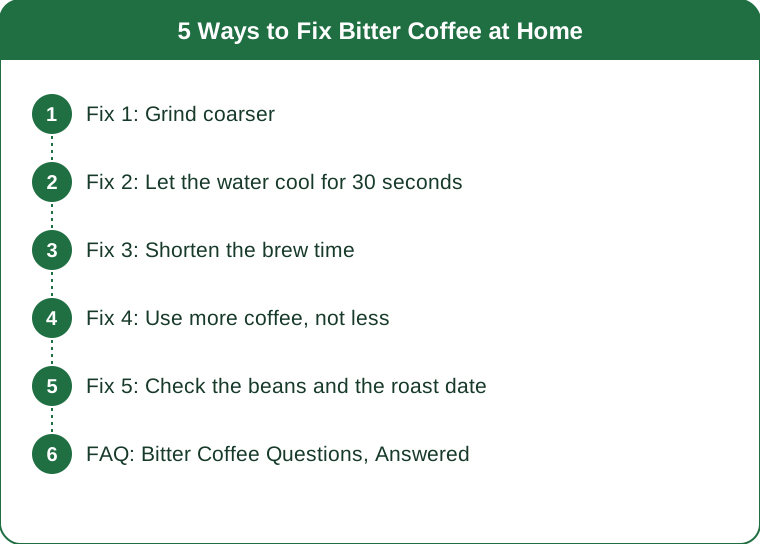
Fix 1: Grind coarser
This is the first thing to change and it resolves the majority of bitter coffee at home.
Grind size controls surface area. Finer grounds expose more coffee to water, which speeds extraction - and past a certain point you pull out the harsh, bitter compounds that sit behind the pleasant ones. Everything you want comes out first; bitterness is what arrives last.
Match the grind to the method: espresso wants very fine, moka pot fine, pour-over medium, drip machine medium, French press coarse. A common error is using a pre-ground supermarket bag labelled simply for filter in a French press, where the four-minute steep over-extracts a grind that was never meant for it.
What to do: go one notch coarser and brew again. If it improves but is still bitter, go another notch. If it becomes thin, sour, and weak, you have gone too far - come back one. Sour means under-extracted; bitter means over-extracted, and you are looking for the point between them.
If you use pre-ground coffee, this is the fix you cannot access, which is the strongest practical argument for a burr grinder. Blade grinders produce a mix of dust and boulders, and the dust over-extracts while the boulders under-extract - so you get bitter and sour in the same cup.
Fix 2: Let the water cool for 30 seconds
Hotter water extracts faster, and water straight off a rolling boil is above the range coffee wants.
The usual recommended brewing range is roughly 195 to 205 degrees Fahrenheit, or 90 to 96 Celsius. Water at a full boil is 212 Fahrenheit and sits above that window, pulling bitter compounds more aggressively from the moment it hits the grounds.
This is one of the most common home errors because it is invisible - the kettle clicks off and you pour immediately.
What to do: after the kettle boils, wait 30 to 45 seconds before pouring. That is roughly enough to land in range in a normal kitchen. If your kettle has a temperature setting, use 200 Fahrenheit or 93 Celsius as a starting point.
One nuance worth knowing: darker roasts are more soluble and extract faster, so they generally want slightly cooler water than lighter roasts. If you drink a dark roast and it is persistently bitter, try 195 Fahrenheit.
Fix 3: Shorten the brew time
Time and grind work together, and if you have already adjusted the grind, time is the next lever.
Rough targets by method: espresso 25 to 30 seconds, pour-over 2.5 to 4 minutes total, drip machine around 5 minutes, French press 4 minutes of steeping.
The most common time error is the French press left standing while you do something else. At eight minutes it is meaningfully more bitter than at four, and the grounds continue extracting the entire time they are in contact with water.
What to do: time your brew properly rather than estimating. For a French press, plunge and decant into another vessel at four minutes - leaving the coffee sitting on the grounds in the press is a guaranteed slow slide into bitterness. For pour-over, if the drawdown is taking well over four minutes, your grind is still too fine and you are back to fix one.
A useful signal: bitterness that gets noticeably worse toward the bottom of the pot usually means time, not grind.

Fix 4: Use more coffee, not less
Counterintuitive and frequently the answer. Weak bitter coffee is usually under-dosed, not over-brewed.
If you use too little coffee for the volume of water, that small amount of coffee gets over-extracted - the water takes everything it can from the grounds, including the bitter fraction, and you end up with something both weak and harsh. The instinct is to conclude the coffee is too strong and use even less, which makes it worse.
The standard starting ratio is roughly 1 to 16 by weight - 60 grams of coffee per litre of water, or about 15 grams for a 240ml cup. Stronger preferences go to 1:15; lighter to 1:17.
What to do: weigh it once. A kitchen scale is the single most useful piece of coffee equipment after a grinder, because scoops vary enormously depending on grind size and bean density. Most people who measure for the first time discover they have been using considerably less coffee than they thought.
If your coffee is bitter and thin at the same time, this is almost certainly your problem.
Fix 5: Check the beans and the roast date
If the first four fixes have not solved it, the beans are the variable.
Roast level. Darker roasts contain more of the compounds associated with bitterness - roasting develops them. If you have adjusted everything and it remains bitter, a medium roast may simply suit you better. This is preference, not a fault.
Staleness. Coffee is best somewhere between about a week and a month after roasting. Older coffee loses aromatic compounds first, leaving a flatter, harsher profile behind. A bag with no roast date on it has usually been sitting long enough that the date would not have flattered it.
Storage. Airtight, room temperature, away from light. Not in the fridge, where condensation and odour absorption both cause problems. The freezer works for long-term storage of unopened bags, but repeated freeze-thaw cycles on a bag you dip into daily do not.
And the equipment. Old coffee oils go rancid and taste bitter. If your machine, French press, or pour-over cone has not been properly cleaned in months, that residue is in every cup. A thorough clean is free and occasionally solves the whole problem on its own.
What to do: buy a bag with a roast date, use it within a month, and clean your equipment properly before you conclude anything about your technique.
FAQ: Bitter Coffee Questions, Answered
How do I tell bitter from sour?
Bitter is a harsh, drying, lingering sensation at the back of the tongue - over-extraction. Sour is sharp and acidic at the sides of the tongue, often with a thin body - under-extraction. If you taste both at once, your grind is inconsistent, which usually means a blade grinder.
Does water quality matter?
Yes, more than most people expect. Very hard water over-extracts and leaves scale; distilled water extracts poorly because minerals are part of the process. Filtered tap water is the practical sweet spot for nearly everyone.
Why is my coffee bitter only some mornings?
Usually grind consistency or water temperature drifting, but check the obvious: are you using a different scoop, or is the bag nearly empty? The bottom of a bag is both staler and often finer, since fine particles settle downward.
Is dark roast always bitter?
No, but it has a smaller margin for error. Dark roasts are more soluble and over-extract more readily, so they benefit from a slightly coarser grind and slightly cooler water than a medium roast in the same brewer.
TL;DR:
- Bitter means over-extracted. Sour means under-extracted. You are aiming between them.
- Grind coarser first - it fixes most home bitterness, and one notch at a time.
- Wait 30 to 45 seconds after the kettle boils. Full boil is above the brewing range.
- Time the brew and decant a French press at four minutes rather than leaving it on the grounds.
- Use more coffee, not less. Weak and bitter at once means under-dosed - start at 1:16 by weight.
- Check the roast date and clean the equipment. Rancid oils taste bitter in every cup.
Change one thing per brew and taste. Working through these in order finds the problem in a couple of days, and it is almost always the grind or the water temperature.
Keep Reading
This article is for general informational purposes only and is not medical advice. Always consult a qualified health professional for guidance specific to you.