Five Coffee Setups for Small Kitchens
Quick Answer: The best small-kitchen coffee setup is the one with the fewest separate objects. A French press needs one vessel and no filters; a pour-over needs three pieces but stores flat; an AeroPress does the most in the least space. Match the setup to your counter, not to a review.
The constraint in a small kitchen is not money and it is rarely skill. It is linear inches of counter and the number of things you are willing to store, wash, and look at every day.

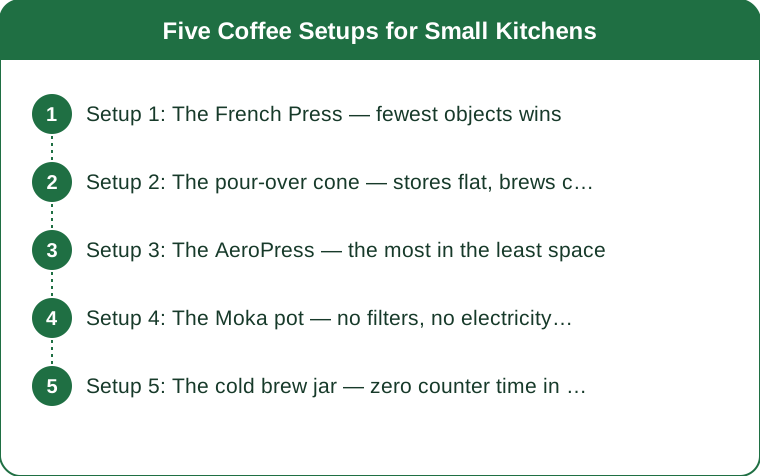
Setup 1: The French Press — fewest objects wins
What it is: One vessel, one plunger, a kettle you probably already own. That is the entire setup.
Counter footprint: About 4 inches of diameter, and it can live in a cupboard between uses without disassembly.
How it brews: Coarse grind, 1:15 ratio — 30g coffee to 450g water. Pour, stir at 30 seconds, lid on, plunge at 4 minutes. No filters to buy or run out of.
What you give up: Sediment in the cup, and a cleanup step that involves getting wet grounds out of a narrow cylinder. A spoon and the bin is the honest method; do not put them down the drain.
Who it is for: People who make two or more cups at once and hate consumables. It is the lowest-maintenance real setup that exists, and the cup is full-bodied and forgiving of imprecise grinding.
Setup 2: The pour-over cone — stores flat, brews clean
What it is: A plastic or ceramic cone, paper filters, a carafe or just your mug, and ideally a kettle with a narrow spout.
Counter footprint: Near zero. A plastic cone hangs on a hook or nests in a mug. This is the setup for kitchens with genuinely no spare surface.
How it brews: Medium grind, 1:16 — 22g to 350g. Bloom with 50g of water for 30-45 seconds, then pour in slow circles to finish around 3 minutes total.
What you give up: Filters as an ongoing purchase, and a technique that rewards attention. Rushed pours give you sour, thin coffee.
Who it is for: Single-cup drinkers who want a clean, bright cup and have three minutes. It is also the cheapest way to find out whether you actually care about the difference.

Setup 3: The AeroPress — the most in the least space
What it is: A plunger, a cap, small paper discs, a stirrer. Everything nests inside itself and fits in a drawer.
Counter footprint: Effectively none. It is the only setup here that stores in a drawer fully assembled.
How it brews: Fine-medium grind, 17g to 220g water, steep 90 seconds, press for 20-30 seconds. It also makes a concentrate for iced or milk drinks, which none of the others do as well.
What you give up: It makes one cup at a time, firmly. Two people means two rounds.
Who it is for: Small kitchens, and anyone who wants one device that covers hot coffee, concentrate, and travel. Cleanup is genuinely the best of the five — the puck ejects into the bin as a solid disc, and a rinse finishes it.
Setup 4: The Moka pot — no filters, no electricity, real intensity
What it is: A stovetop pot in two chambers with a basket between. One object, no consumables.
Counter footprint: Small, and it lives on the stove or in a cupboard.
How it brews: Fine-ish grind, fill the base to just below the valve with hot water, level the basket without tamping, medium-low heat, pull it off the moment it starts to gurgle.
What you give up: A learning curve and no forgiveness for high heat, which produces genuinely bitter coffee. Also a rubber gasket that needs replacing every year or so.
Who it is for: People who want something strong for milk drinks without an espresso machine or its footprint. Starting with hot water in the base is the single change that fixes most bad moka pot coffee.
Setup 5: The cold brew jar — zero counter time in the morning
What it is: Any large jar and a way to strain — a dedicated filter basket, or a fine sieve and a paper filter.
Counter footprint: None during the day. It occupies fridge space instead, which in a small kitchen is a real trade to consider.
How it brews: Coarse grind, 1:8 for concentrate — 100g coffee to 800g water. Room temperature 12-16 hours or fridge for 18-24, then strain. Dilute 1:1 or more.
What you give up: Planning. There is no such thing as spontaneous cold brew.
Who it is for: Anyone whose mornings are the constraint rather than their counter. One batch covers four to five days, and as the mornings cool you can heat the concentrate with hot water for a surprisingly good hot cup.
TL;DR:
- French press: fewest objects, most forgiving, messiest cleanup. Best for two-cup households.
- Pour-over: stores flat, cleanest cup, needs filters and attention.
- AeroPress: smallest footprint, best cleanup, one cup at a time.
- Moka pot: no consumables, strong enough for milk drinks, start with hot water in the base.
- Cold brew: no morning time at all, but trades counter space for fridge space.
If you are choosing one and your kitchen is genuinely tight, the AeroPress and the pour-over are the two that disappear completely between uses. If you make coffee for two people every morning, the French press wins on the thing that actually matters day to day, which is how many separate objects you have to handle before you are awake.
Keep Reading
This article is for general informational purposes only and is not medical advice. Always consult a qualified health professional for guidance specific to you.