Does Coffee Before a Workout Actually Help You Recover Faster?
You already know coffee gets you through the workout. What’s less clear is what it does after — does that pre-workout cup actually make you less sore tomorrow, or is that just something people tell themselves to justify a second cup?

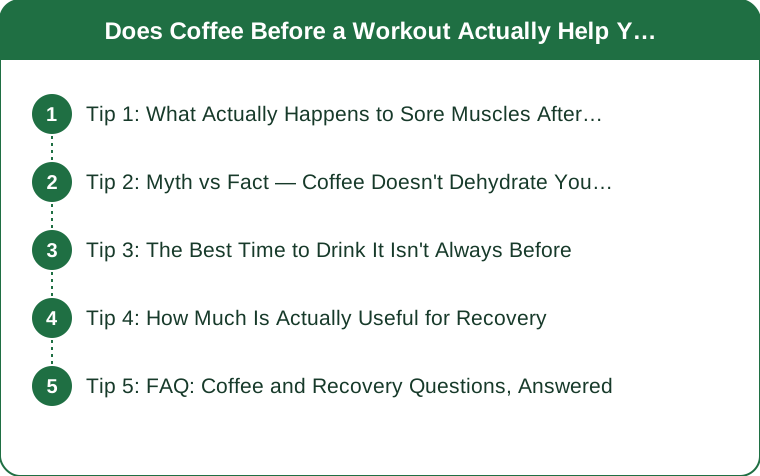
Tip 1: What Actually Happens to Sore Muscles After Caffeine
Caffeine is a mild anti-inflammatory, which is part of why it shows up in some post-workout recovery research. Studies on caffeine and delayed-onset muscle soreness (DOMS) show a modest effect — people who take caffeine before a hard lifting session sometimes report less pain the following two days, roughly 25-50% less on a subjective soreness scale.
That’s not nothing, but it’s also not a substitute for actual recovery basics. Think of it as a small edge, not a fix for skipping protein or sleep.
Tip 2: Myth vs Fact — Coffee Doesn’t Dehydrate You Post-Workout
Myth: coffee cancels out your hydration and leaves you worse off after sweating. Fact: for people who drink it regularly, coffee’s diuretic effect is mild and doesn’t meaningfully offset the fluid you take in with it. A 2019 review in the Journal of the International Society of Sports Nutrition found regular coffee drinkers see no significant hydration deficit from moderate intake.
The real hydration miss is usually skipping water entirely because you ‘already had a drink’ this morning.

Tip 3: The Best Time to Drink It Isn’t Always Before
Pre-workout caffeine (about 200mg, 45-60 minutes ahead) is well studied for performance. But for recovery specifically, a small cup after training may matter more — it can blunt the perception of soreness during the window when inflammation markers peak, roughly 24-48 hours out.
If you only get one cup a day, splitting your usual dose — half before, half a few hours after — is a reasonable middle ground worth testing for two weeks.
Tip 4: How Much Is Actually Useful for Recovery
More isn’t better here. Doses above 300mg (about three regular cups) haven’t shown extra recovery benefit in the research and start pushing into territory that disrupts sleep — which matters far more for actual muscle repair than the coffee itself.
A practical target: 100-200mg total on training days, timed so the last dose is at least 8 hours before bed.
Tip 5: FAQ: Coffee and Recovery Questions, Answered
Does decaf give any recovery benefit?
Decaf still has trace caffeine and the same antioxidant compounds (chlorogenic acids), so you get a small anti-inflammatory effect without the sleep tradeoff — a reasonable evening option.
Can coffee replace a proper cooldown or stretching?
No. It changes how soreness feels, not the actual repair process. Pair it with the basics, don’t swap it in for them.
Is cold brew different from hot coffee for this purpose?
Not meaningfully — caffeine content is what matters, and cold brew can actually run higher per ounce, so watch your total dose.
TL;DR:
- Caffeine has a real but modest effect on perceived soreness (25-50% less on subjective scales)
- It doesn’t dehydrate regular drinkers in any way that matters
- A post-workout cup may help more than people assume — try splitting your dose
- Stay under 200mg on training days and cut off 8 hours before bed
Your coffee habit isn’t hurting your recovery, and it might be quietly helping — just don’t expect it to do the job protein and sleep are supposed to do.
Keep Reading
This article is for general informational purposes only and is not medical advice. Always consult a qualified health professional for guidance specific to you.