5 Coffee-and-Workout Timing Scenarios (And What Actually Works Best)
Quick Answer: Caffeine’s performance benefit peaks around 30-60 minutes after intake, but the ideal timing shifts depending on workout type, time of day, and whether you’re training fasted — here are the 5 most common scenarios and what to do in each.
“Drink coffee 30-60 minutes before working out” is true, but it’s also incomplete — a fasted morning lift and an evening cardio session call for genuinely different approaches.

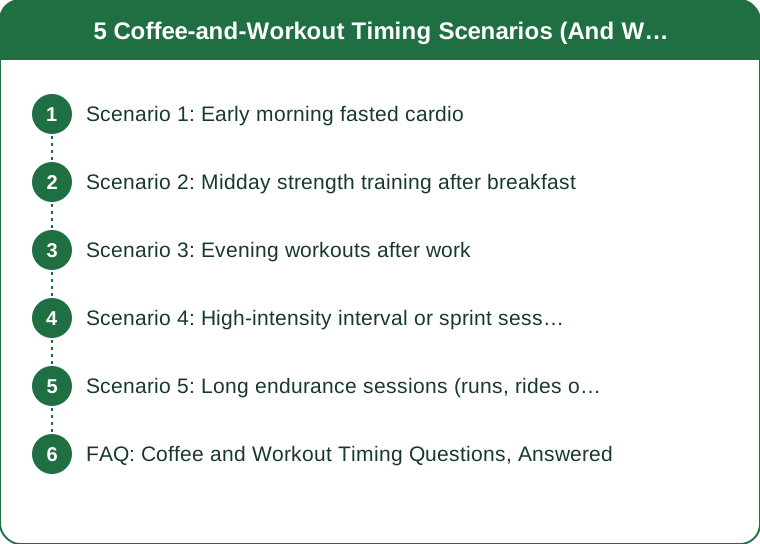
Scenario 1: Early morning fasted cardio
Caffeine here does double duty — performance boost plus appetite suppression for the fasted state. Timing 30-45 minutes before is typical, but starting with a smaller dose (half a normal cup) matters more here since a fasted stomach absorbs caffeine faster and jitters hit harder without food buffering it.
Scenario 2: Midday strength training after breakfast
This is the most forgiving scenario — food in your system smooths out caffeine absorption, so a full cup 45-60 minutes before lifting works well without the jitter risk of the fasted version. This is also where caffeine’s documented strength and power output benefits are most reliably felt.
Scenario 3: Evening workouts after work
Caffeine’s half-life is roughly 5-6 hours, meaning an evening coffee before a workout can still be affecting sleep onset at 10pm or later. If sleep quality matters more than the performance edge, a half-dose or an earlier afternoon coffee paired with a caffeine-free pre-workout warm-up is the better trade.

Scenario 4: High-intensity interval or sprint sessions
Caffeine’s effect on perceived exertion — making hard efforts feel more manageable — is particularly useful for HIIT-style sessions where mental push-through matters as much as raw energy. A slightly earlier timing window (45-60 minutes) gives the full effect time to kick in before the first hard interval.
Scenario 5: Long endurance sessions (runs, rides over 90 minutes)
Beyond the pre-workout dose, some endurance athletes use a small caffeine top-up mid-session (via gel or gum) since the initial dose’s peak effect fades before a long session ends. This is a more advanced strategy — the pre-workout dose alone is sufficient for most people’s typical training runs.
FAQ: Coffee and Workout Timing Questions, Answered
Does the type of workout really change optimal caffeine timing?
The general 30-60 minute window holds across workout types, but food status, time of day, and session length shift the practical details — dose size, sleep impact, and whether a mid-session top-up is worth it.
Is coffee before a workout better than a pre-workout supplement?
Both deliver caffeine as the primary active ingredient; coffee is a reasonable substitute for many people, though pre-workout supplements often combine caffeine with other ingredients (beta-alanine, citrulline) coffee doesn’t provide.
How late in the day can I have pre-workout coffee without hurting sleep?
Generally, avoiding caffeine within 6-8 hours of bedtime is the safer window, given caffeine’s several-hour half-life.
TL;DR:
- Fasted morning cardio needs a smaller dose to avoid jitters
- Post-breakfast strength training is the most forgiving timing scenario
- Evening workouts require weighing performance against sleep disruption
- HIIT sessions benefit from caffeine’s effect on perceived exertion specifically
- Long endurance sessions may benefit from a mid-session caffeine top-up
Match the timing to the scenario, not a single fixed rule.
Keep Reading
This article is for general informational purposes only and is not medical advice. Always consult a qualified health professional for guidance specific to you.