Coffee and Your Health: The Honest Science of Your Favorite Habit
Few daily pleasures have survived as much scientific scrutiny as coffee — decades of suspicion, hundreds of studies, and a verdict that keeps landing in coffee’s favor: moderate consumption associates with lower risks of several major diseases and, per large meta-analyses, modestly lower all-cause mortality. Your favorite habit is, for most women, quietly on your side. But the fine print — timing, anxiety, sleep, and what you stir into it — decides whether your particular cup helps or hinders. Here is the honest brief. (Pregnancy, heart conditions and medication interactions move caffeine questions to your doctor — the 200mg pregnancy guideline being the famous one.)

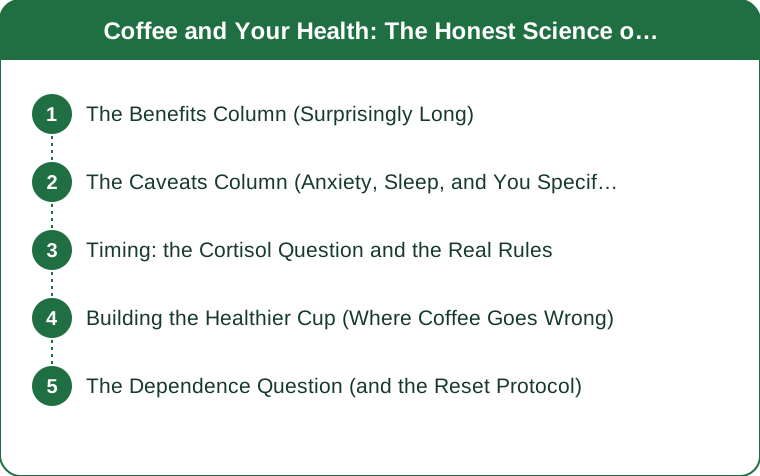
The Benefits Column (Surprisingly Long)
The evidence stack: habitual coffee drinking associates with lower risks of type 2 diabetes, Parkinson’s, liver disease (the liver findings are notably consistent), and depression in women specifically (multiple large cohorts) — with the mortality curves bottoming around 3–4 cups daily. The mechanisms go beyond caffeine: coffee is many women’s single largest dietary source of polyphenol antioxidants (decaf shares most non-caffeine benefits — the underrated fact of the field). Honest framing: these are associations from observational research, not prescriptions — but the direction and consistency earned coffee its rehabilitation. The beverage needs no guilt. The additions might.
The Caveats Column (Anxiety, Sleep, and You Specifically)
Where coffee earns its warnings: caffeine metabolism varies genuinely by genetics — slow metabolizers feel one cup for eight hours while fast ones shrug off three (you already know which you are; believe your data over averages), anxiety is dose-sensitive (caffeine mimics and amplifies the physiology of anxious arousal — jittery weeks deserve smaller or later-abandoned doses, and anxiety-prone women often thrive on half-caf), sleep is the big tax (caffeine’s five-to-six-hour half-life means the 3pm cup is 25% on duty at 9pm — the afternoon cutoff is the single highest-value coffee rule), and reflux and iron interactions round out the list (coffee with iron-rich meals blocks absorption — separate them by an hour, a footnote that matters for low-ferritin women). Coffee is a drug with a fan club. Dose it like both are true.

Timing: the Cortisol Question and the Real Rules
Sorting trend from evidence: the delay-your-coffee-90-minutes ritual (waiting past the morning cortisol peak) has plausible-but-thin support — if it works for you, lovely; it is not a commandment. The rules with actual weight: the afternoon cutoff (2pm for most, noon for slow metabolizers — non-negotiable for sleep quality), the with-or-after-food guideline for sensitive stomachs, and the nap hack for the curious (caffeine before a 20-minute nap times the kick to the wake-up — the espresso-nap is real physiology and a delightful party fact). Total dose guidance: up to ~400mg daily (3–4 cups) sits within safety consensus for most adults; your anxiety, sleep and heart get veto power below that ceiling.
Building the Healthier Cup (Where Coffee Goes Wrong)
The cup itself is nearly calorie-free and beneficial; the additions run the spectrum: the daily blended caramel construction is a dessert with a coffee alibi (500-plus calories, half a day’s sugar — fine as dessert, ruinous as a default), while the healthier ladder runs: black or with a splash (the ideal, acquirable by gradual weaning), unsweetened milk or oat milk plus cinnamon (the satisfying compromise), and the at-home latte habit that saves both sugar and serious money. Brew-method footnote for the cholesterol-aware: unfiltered coffee (French press, espresso) carries compounds that can nudge LDL; paper-filtered drip removes them — a switch worth knowing if your lipid panel is a project. The habit is healthy. Keep the construction honest.
The Dependence Question (and the Reset Protocol)
The honest relationship audit: caffeine dependence is real but mild as dependencies go — the tell is needing coffee to reach baseline rather than to feel good, plus the weekend withdrawal headache. If your dose has crept or sleep has eroded, the reset: taper rather than quit cold (halve doses over two weeks — half-caf is the tool built for this; cold turkey buys a week of headaches for no extra benefit), hold the afternoon cutoff sacred during and after, and rediscover your actual sensitivity at the lower dose (most resetters report the pleasant surprise: one good cup working like three used to). Coffee serves best as a chosen pleasure with a schedule — not an IV line with a personality. The ritual, reclaimed, is the whole point.
Coffee, honestly briefed: genuinely health-associated at moderate doses, taxed mainly through sleep and anxiety, governed by one great rule (the afternoon cutoff) and one great trap (the dessert-in-disguise cup). Keep the habit, schedule the doses, filter if your cholesterol asks, and let the 2pm cutoff buy back your sleep. The morning cup was never the problem — and now it has a clean bill and a curfew.
Keep Reading
This article is for general informational purposes only and is not medical advice. Always consult a qualified health professional for guidance specific to you.