Iced Coffee at Home: Stop Paying $7 for Watered-Down Regret
Quick Answer: Two methods cover everything. Cold brew: coarse grounds and cold water at a 1:8 ratio, 12–18 hours in the fridge, strained — smooth, low-acid, keeps a week. Japanese-style flash chill: brew hot at double strength directly onto ice — brighter, ready in four minutes. Freeze leftover coffee into ice cubes so dilution stops ruining the last third of the glass. Cost per glass: about $0.60.
Every summer, an extraordinary number of us hand over $7 for a drink that tastes like someone described coffee to a glass of milk from another room.
Meanwhile the home version costs sixty cents and requires less skill than making toast. The barista is lovely. The math is not.

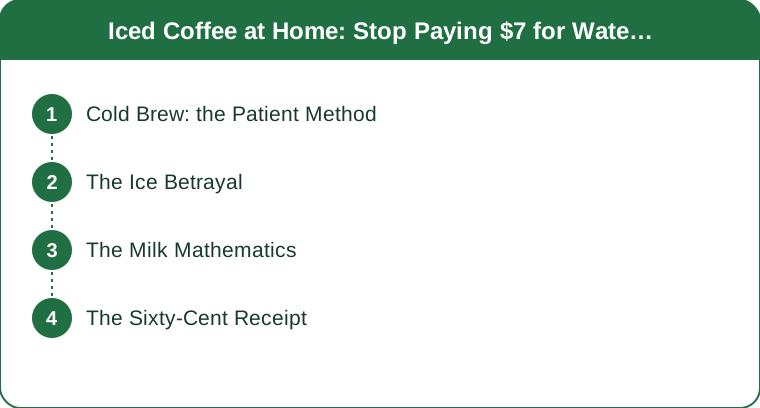
How Do You Make Cold Brew at Home?
The patient method, and the one worth doing on a Sunday.
The recipe:
- Coarse grind — like breadcrumbs, not powder. Fine grounds turn cold brew muddy and bitter and make straining miserable
- 1:8 ratio — 100g coffee to 800ml cold water for a concentrate you’ll dilute, or 1:12 for ready-to-drink
- Stir once, make sure all grounds are wet
- 12–18 hours in the fridge. Room temperature works faster (8–12 hours) but the fridge gives a cleaner result
- Strain through a sieve lined with a coffee filter or a clean tea towel
Equipment list: a jar and a sieve. That’s genuinely it. A dedicated cold brew maker is convenient and not remotely necessary.
Why it tastes different: cold water extracts fewer of the acidic and bitter compounds that hot water pulls out. The result is smoother, sweeter, and noticeably lower in perceived acidity — which is why people who find hot coffee harsh often get on well with it.
It keeps for about a week in the fridge, which makes it the make-once-drink-all-week option. One Sunday jar covers five mornings.
What About Ice Ruining Everything?
The ice betrayal is real, and it’s the actual reason most home iced coffee disappoints.
Regular ice cubes made of water dilute your coffee into sadness within about six minutes. The first two sips are good; the last third is brown water.
Fix 1: coffee ice cubes. Freeze leftover brew or cold brew in an ice tray. As they melt, they add coffee rather than subtracting it. This is the single best trick in home iced coffee and it costs nothing — you’re using coffee you’d otherwise pour away.
Fix 2: Japanese-style flash chill. Brew hot coffee at roughly double strength directly onto ice, so the ice melt is your dilution water, calculated in advance.
The method:
- Use your normal pour-over or drip setup
- Use your normal amount of coffee, but halve the brewing water and put the other half in the carafe as ice
- Brew directly onto the ice
You get the brightness and aromatics of hot-brewed coffee — which cold brew genuinely loses — chilled instantly. It takes four minutes rather than eighteen hours, which makes it the “I want iced coffee now” method.
Cold brew vs flash chill, briefly: cold brew is smoother, sweeter, lower acid, and keeps for days. Flash chill is brighter, more complex, more like the coffee actually tastes, and has to be made fresh. Most people end up making both for different moods.

How Do You Get Café-Style Cold Foam?
Two options, neither of which requires equipment worth mentioning.
The jar method (free): pour cold milk into a jar, seal it, shake hard for 30 seconds. Genuinely works. Half-fill at most or you’ll spend the next ten minutes cleaning.
A handheld milk frother ($12): faster, more consistent, produces a denser foam. If you’re doing this daily, it pays for itself in a week.
Which milk foams best: oat milk foams like a dream and is the reliable non-dairy choice. Whole dairy milk gives the richest foam; skimmed produces more volume but less stability. Almond milk is the difficult one — the barista-formulated versions foam, the standard ones mostly don’t.
For sweetness, a simple syrup (equal parts sugar and hot water, stirred, cooled, kept in the fridge) dissolves in cold coffee where granulated sugar simply won’t. Add vanilla, cinnamon, or a coffee-shop-style flavour to the syrup and you’ve replicated the $7 drink exactly.
The expensive version was about 80% presentation. That presentation is now yours.
5 Mistakes Everyone Makes
1. Grinding too fine for cold brew. Produces a cloudy, over-extracted, silty result that’s a nightmare to strain. Coarse, always.
2. Pouring hot coffee over ice and calling it done. Without doubling the strength, you get precisely the watered-down drink you were trying to avoid.
3. Using granulated sugar in cold coffee. It doesn’t dissolve. It sits at the bottom and then arrives all at once in the final mouthful. Make simple syrup.
4. Leaving cold brew steeping too long. Past about 24 hours it turns bitter and woody. It is not a slow cooker; more time is not more flavour.
5. Using stale beans because “it’s iced anyway.” Cold brew is more forgiving than espresso, not immune. Beans more than a month past roast date taste flat in any format.
Does It Actually Save That Much Money?
The receipt:
- Beans bought in bulk: roughly $0.35 per glass
- Tap water and your own ice: $0.00
- Milk: about $0.20
- Total: roughly $0.60 per glass
Against a $7 café drink, that’s a $6.40 gap. Five days a week, fifty weeks a year, comes to around $1,600 annually — a fairly nice holiday funded entirely by not standing in a queue.
The honest caveat: some of that $7 buys you leaving the house, seeing another human, and not doing washing up. Those aren’t nothing. The point isn’t that cafés are a scam — it’s that the default being a café is expensive, and having a good jar of cold brew in the fridge turns it back into a choice.
Frequently Asked Questions
How long does cold brew last in the fridge?
Undiluted concentrate keeps well for about 7–10 days; once diluted with water or milk it’s best within 2–3 days. Store it in a sealed container — coffee absorbs fridge smells enthusiastically, and cold brew that tastes faintly of last night’s curry is a genuinely disappointing outcome.
Is cold brew stronger than regular coffee?
Concentrate is much stronger before dilution — often two to three times the caffeine of a standard cup by volume. Once diluted at the usual 1:1 with water or milk, it lands roughly comparable to a normal coffee, though this varies with your ratio. If you’re sensitive to caffeine, dilute more heavily and check how you feel before making it a daily habit.
What beans work best for iced coffee?
Medium roasts are the safest all-rounder — dark roasts can turn ashy in cold brew, while very light roasts sometimes under-extract and taste thin. For flash-chilled coffee, a fruity light-to-medium roast shines, since the method preserves the brightness that cold brew flattens. Experiment; the beans matter more here than most people expect.
TL;DR:
- Cold brew: coarse grind, 1:8 ratio, 12–18 hours in the fridge, strain. Jar and sieve, no equipment
- Flash chill: halve the brew water, replace it with ice in the carafe, brew hot onto it. Four minutes
- Freeze leftover coffee as ice cubes — the single best fix for dilution
- Cold foam: shake cold milk in a jar for 30 seconds, or use a $12 frother. Oat foams beautifully
- Use simple syrup, not granulated sugar — sugar won’t dissolve in cold coffee
- Don’t steep past 24 hours, and don’t grind fine
- About $0.60 a glass vs $7. Five days a week is roughly $1,600 a year
Jar of cold brew on Sunday, coffee ice cubes always, milk shaken not bought. The drive-through can keep the queue.
Keep Reading
This article is for general informational purposes only and is not medical advice. Always consult a qualified health professional for guidance specific to you.